 Call us: +48 58 6228900
 Feedback
 Newsletter





SRAM
SRAM (Static Random Access Memory) is a type of fast, non-volatile memory with random access, providing instant access to stored data without the need for periodic refreshing, unlike DRAM. Thanks to its high performance and low latency, SRAM is indispensable in applications that require real-time data processing—such as processor buffers, cache memory, FPGA circuits, embedded systems, medical devices, industrial electronics, and telecommunications equipment.
What is SRAM and how does it work?
SRAM stores data in memory cells built from multiple transistors (typically 4 to 6), which maintain a logic state as long as power is supplied. Unlike DRAM, SRAM does not require data refreshing, resulting in significantly faster access and lower latency.
Key Features of SRAM:
✔ Capacity – from kilobits to megabits (e.g., 64Kb, 256Kb, 1Mb, 4Mb, 16Mb)
✔ Access time – extremely low, typically between 10 ns and 55 ns
✔ Operating frequency – optimized for high-performance systems
✔ Supply voltage – typically 3.3V or 5V, with low-voltage options (1.8V)
✔ Interface type – parallel (asynchronous or synchronous), less commonly SPI
✔ Operating temperature – industrial ranges from -40°C to +85°C or even +125°C
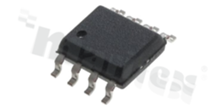
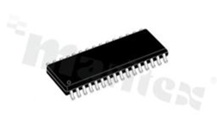
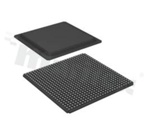
✔ Packaging – TSOP, SOIC, TQFP, BGA – easy to integrate into PCB designs
Applications of SRAM:
SRAM is essential wherever fast access and operational reliability are crucial:
• Data buffers and processor cache – fast storage of temporary data
• Embedded systems and microcontrollers – extra working memory for real-time applications
• FPGA and DSP systems – storing configuration and computational data
• Medical and measurement devices – safe and rapid storage of measurement results
• Industrial automation – high-speed data processing in real-time control systems
• Telecommunication systems – real-time data packet buffering
• Networking equipment and routers – managing data transmission and routing tables
Types of SRAM:
Asynchronous SRAM
✔ Does not require a system clock
✔ Fast access time – ideal for simpler architectures
✔ Examples: CY7C199, IS61C5128, AS6C4008
Synchronous SRAM (SSRAM)
✔ Works with a clock signal – enables better synchronization and performance
✔ Used in modern FPGA and processor systems
✔ Examples: IS61LV25616, CY7C1354G, MCM63P636
Serial Interface SRAM (SPI SRAM)
✔ Compact and energy-efficient – ideal for IoT and portable devices
✔ Examples: 23LC1024, LY68L6400, MB85RS2MT (FRAM-like performance with SRAM interface)
Why Choose SRAM?
✔ Extremely fast data access – perfect for real-time applications
✔ No refresh required – stable and reliable operation without additional cycles
✔ Low latency – instant response to data requests
✔ Excellent for buffering and caching – vital for high-load systems
✔ Wide range of applications – from mobile devices to advanced industrial systems
✔ Noise immunity – stable performance in industrial environments
 PDF
PDF

|
Quantity pcs. |
Net price PLN/pcs. |
|---|---|
| 1+ | 7.18 |
| 100+ | 6.87 |
| 500+ | 6.63 |
| 3300+ | 6.63 |
|
Quantity pcs. |
Net price PLN/pcs. |
|---|---|
| 1+ | 22.39 |
| 10+ | 19.46 |
| 30+ | 14.83 |
| 100+ | 13.97 |
| 500+ | 12.45 |
| 1000+ | 11.35 |
|
Quantity pcs. |
Net price PLN/pcs. |
|---|---|
| 1+ | 33.57 |
| 5+ | 31.03 |
| 25+ | 29.17 |
| 100+ | 27.88 |
| 250+ | 24.62 |
|
Quantity pcs. |
Net price PLN/pcs. |
|---|---|
| 1+ | 9.43 |
| 5+ | 8.82 |
| 25+ | 8.29 |
| 100+ | 7.69 |
|
Quantity pcs. |
Net price PLN/pcs. |
|---|---|
| 1+ | 16.89 |
| 10+ | 16.04 |
| 20+ | 15.21 |
| 100+ | 14.36 |
|
Quantity pcs. |
Net price PLN/pcs. |
|---|---|
| 5+ | 35.40 |
| 50+ | 28.71 |
| 100+ | 25.17 |
| 300+ | 22.01 |
|
Quantity pcs. |
Net price PLN/pcs. |
|---|---|
| 1+ | 16.52 |
| 10+ | 12.79 |
| 30+ | 10.24 |
| 100+ | 8.75 |
|
Quantity pcs. |
Net price PLN/pcs. |
|---|---|
| 1+ | 229.16 |
| 10+ | 194.67 |
| 30+ | 179.27 |
| 100+ | 162.58 |