Call us: +48 58 6228900
 Feedback
 Newsletter





Electronic component selection – practical guidance from Maritex experts
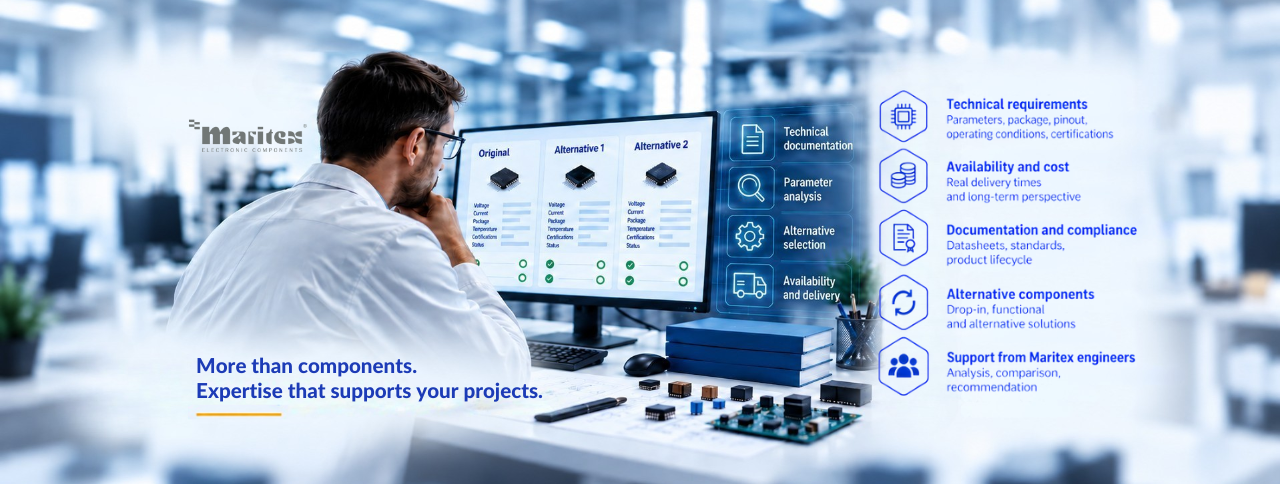
In practice, Maritex engineers most often encounter situations where a customer is looking for a component that meets specific technical requirements while also taking into account availability, price, lead time and long-term suitability for the project. Another common challenge is finding a suitable replacement for an obsolete or difficult-to-source component, preferably without having to modify the PCB or redesign the entire device.
In such cases, the Maritex technical team analyses not only the basic datasheet specifications, but also the package, pinout, operating temperature range, electrical and mechanical parameters, required certifications and the specific requirements of the application. This allows the proposed solution to be evaluated in the context of the entire project rather than solely on the basis of similarities between individual parameters.

The most common mistake when selecting a component is…
Focusing on only one or a few basic datasheet parameters. Two components may have similar voltage, current, power ratings or dimensions, yet still not be directly interchangeable due to differences in pinout, dynamic characteristics, tolerances, mounting method, thermal parameters or drive requirements.
When selecting replacement components in particular, it is essential to review the complete technical documentation and verify the component’s operating conditions within the specific application. Non-technical factors are equally important, including product lifecycle status, availability, required certifications and supply continuity. A replacement should therefore be selected for a specific application rather than solely on the basis of a similar part number or a few matching datasheet parameters.
In our customers’ projects, component selection often requires balancing several different criteria: technical specifications, price, availability, lead time and the long-term production outlook for the device. A component that is technically optimal may not necessarily be the best business choice if its availability is limited or the manufacturer is planning to discontinue the product series.
This is why Maritex supports customers both in new designs and in the modernisation of existing devices. Our support may include component selection, evaluation of alternative solutions, sourcing replacements for unavailable or obsolete components, and verification of technical documentation. This makes it possible to consider not only technical requirements at the design stage, but also component availability throughout the planned lifecycle of the product.
What replacement components do Maritex engineers recommend?
There is no universal list of recommended replacement components – an alternative should always be selected for a specific component and application. Maritex engineers first look for a solution that matches the original component as closely as possible in terms of electrical and mechanical characteristics, package and mounting method.
If the customer requires a replacement that does not involve PCB modifications, dimensional, footprint and pinout compatibility are particularly important. Key electrical, thermal and functional parameters are then compared, together with the applicable standards and required certifications. Product availability and the outlook for continued production are also taken into consideration.
Depending on the project, the recommended solution may be:
- Direct replacement (drop-in / pin-to-pin) – when the component can be used without PCB modifications or with only minimal changes.
- Functional replacement – when the component provides the required functionality and performance but may require hardware or software modifications.
- Alternative component with better availability – when the priority is to ensure production continuity and reduce the risk of future component shortages.
The final replacement should always be qualified and tested in the target application before being approved for production use.
How does the Maritex technical team select a product?
The process begins by defining the actual requirements of the application. The more information the technical team receives – including operating parameters, environmental conditions, mounting method, required certifications, available space and expected production volumes – the more precisely an appropriate solution can be selected.
The specialists then analyse available products and their technical documentation, comparing the key parameters and limitations of each solution. When selecting a replacement component, the technical documentation of the currently used component serves as the primary reference.
Purchasing and logistics considerations are also taken into account, including availability, lead time, MOQ/SPQ, product lifecycle status and the ability to ensure a reliable long-term supply. Based on this analysis, the customer may receive one or more proposed solutions together with an overview of the most important differences.
Component selection therefore does not end with finding a product that meets the required technical specifications. The objective is to identify a solution that is technically suitable, commercially available and viable throughout the entire lifecycle of the project.
What questions should you ask before purchasing an electronic component?
Which parameters are essential, and which can be changed without affecting the operation of the device? This is particularly important when searching for replacement components, as clearly defining the critical parameters can significantly increase the number of suitable alternatives.
It is also worth considering the following questions:
- What are the actual operating conditions of the component – temperature, humidity, vibration and electrical or mechanical loads?
- Does the component require a specific package, footprint or pinout?
- Which standards and certifications must the finished device comply with?
- Will the component be used in a prototype, a short production run or a product manufactured over many years?
- How important is long-term availability?
- Is there an alternative component that could be qualified at the design stage?
It is also important to check the product lifecycle status. Selecting a component that is approaching end-of-life (EOL) may result in the need for a costly redesign of the device in the future.